- Get Started
- Functionality
- Learning
- Extension
- Dev Tooling
- APIs
- Releases
Docs
Authors:
Ankit Mehta, Movyn John, Cille Schliebitz, Anita Gu
Changed on:
23 Sept 2026
 The Fluent OMSThe Fluent Order Management System is a platform that drives the fulfillment of orders. Its main modules like Product Availability, Distributed Order Management, Global Inventory, and Store Fulfillment functionalities are designed to be flexible in integrating with other APIs and Connectors. The Fluent OMS sits in the middle of the architecture and provides a realtime view of the Inventory to the Sales Channels, enabling integration with Warehouse Management Systems, Carrier services, ERPs, etc.
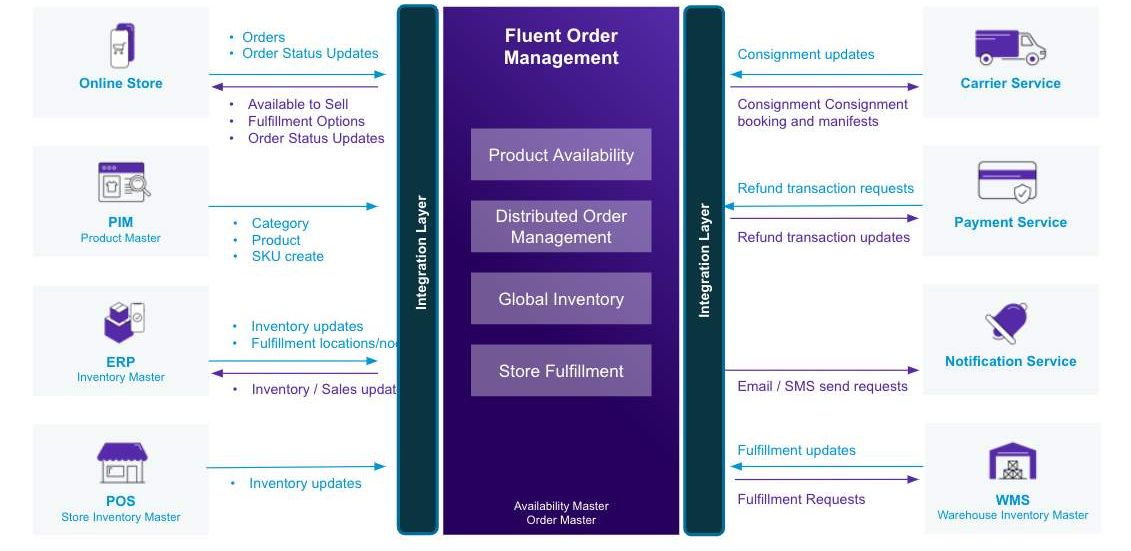 Integration LayersIt is important to note that all the integration payloads coming into and going out of the Fluent OMS need to follow a predefined structure. This is because the Fluent OMS is designed to accept and process payloads in a particular format only.Similarly, third-party systems may follow a payload structure of their own. Hence, in order for Fluent OMS to communicate with third-party systems, they will need to transform their payload structure to a format that Fluent Order Management understands, and vice versa. The Integration Layer, which sits between the Fluent OMS and the third-party systems, carries out this transformation.
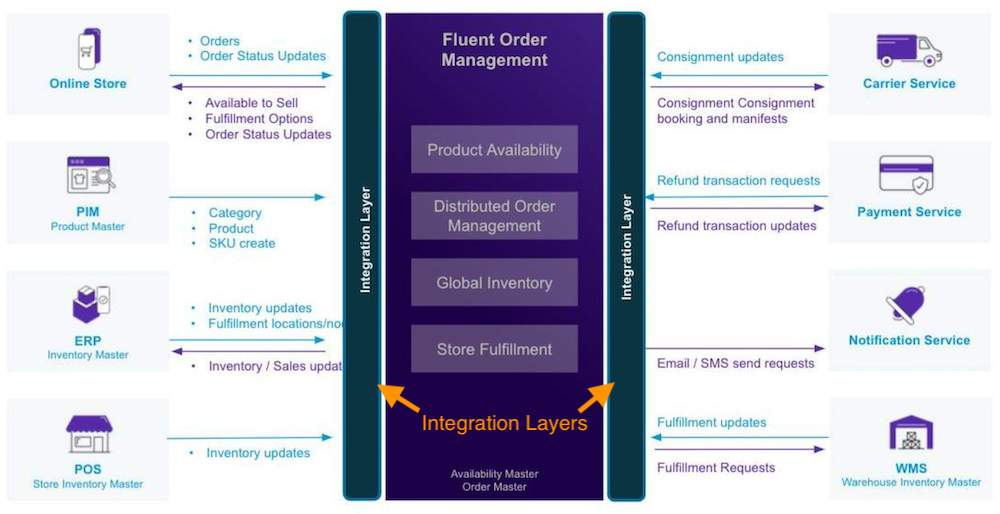 Next, we look at some common interfaces.Common InterfacesThere are many interfaces that you may come across in your projects, below we talk about some of the more common ones and the information that's shared between them and the Fluent Order Management System.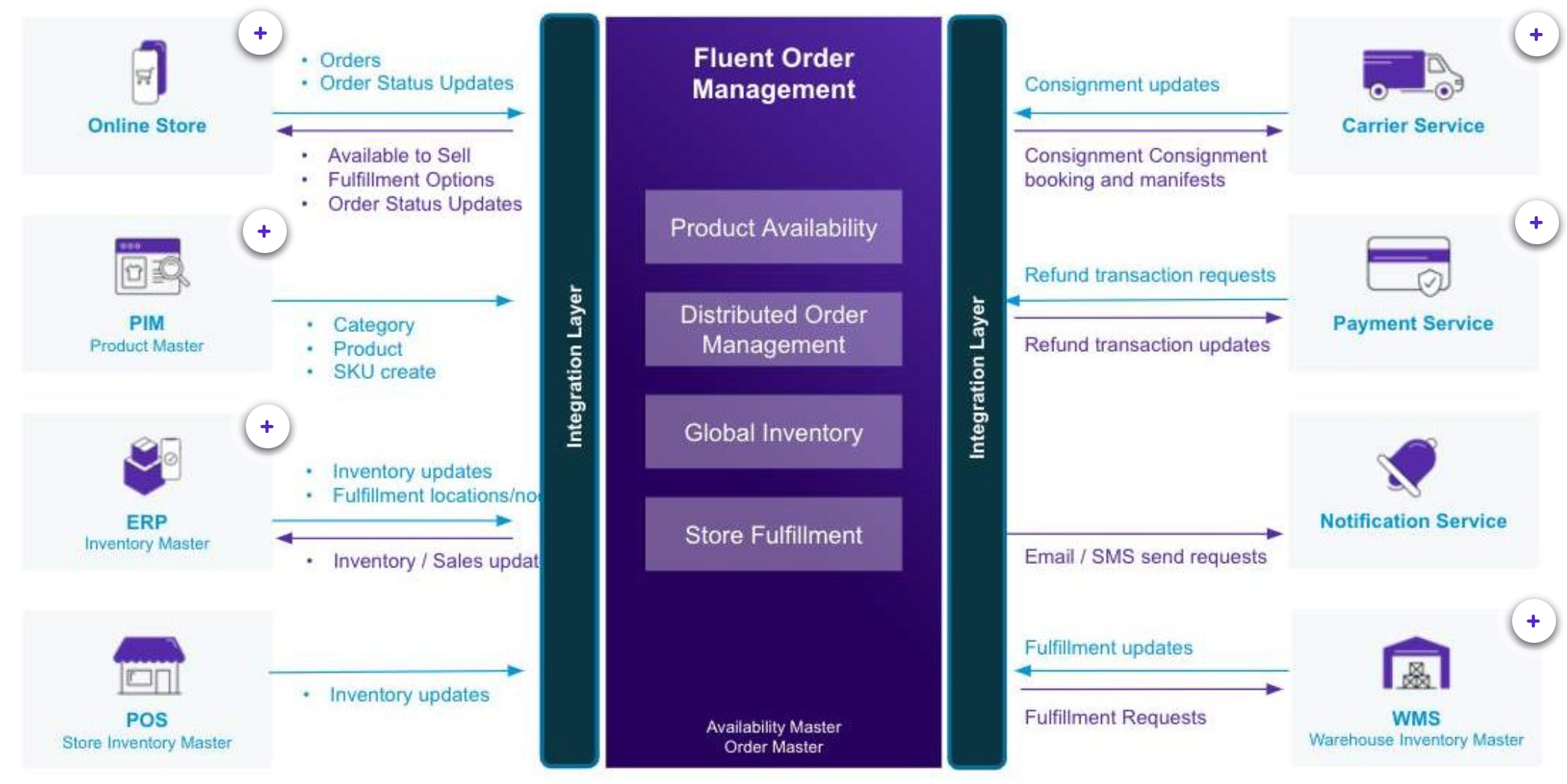
| Online Store | The source of orders can come from:
|
| PIM | Product Information Management systems share the following data with Fluent:
|
| Inventory Master |
|
| Carrier Service | The Carrier Service may:
|
| Payment Service | It can be used for
|
| WMS | The Warehouse Management System or a Drop Ship Vendor may:
|
| Platform (REST) | Fluent's Platform APIs are REST-based and deal with platform-related activities such as:
|
| Domain (GraphQL) | Fluent's Domain related APIs are GraphQL-based and used for activities such as:
|
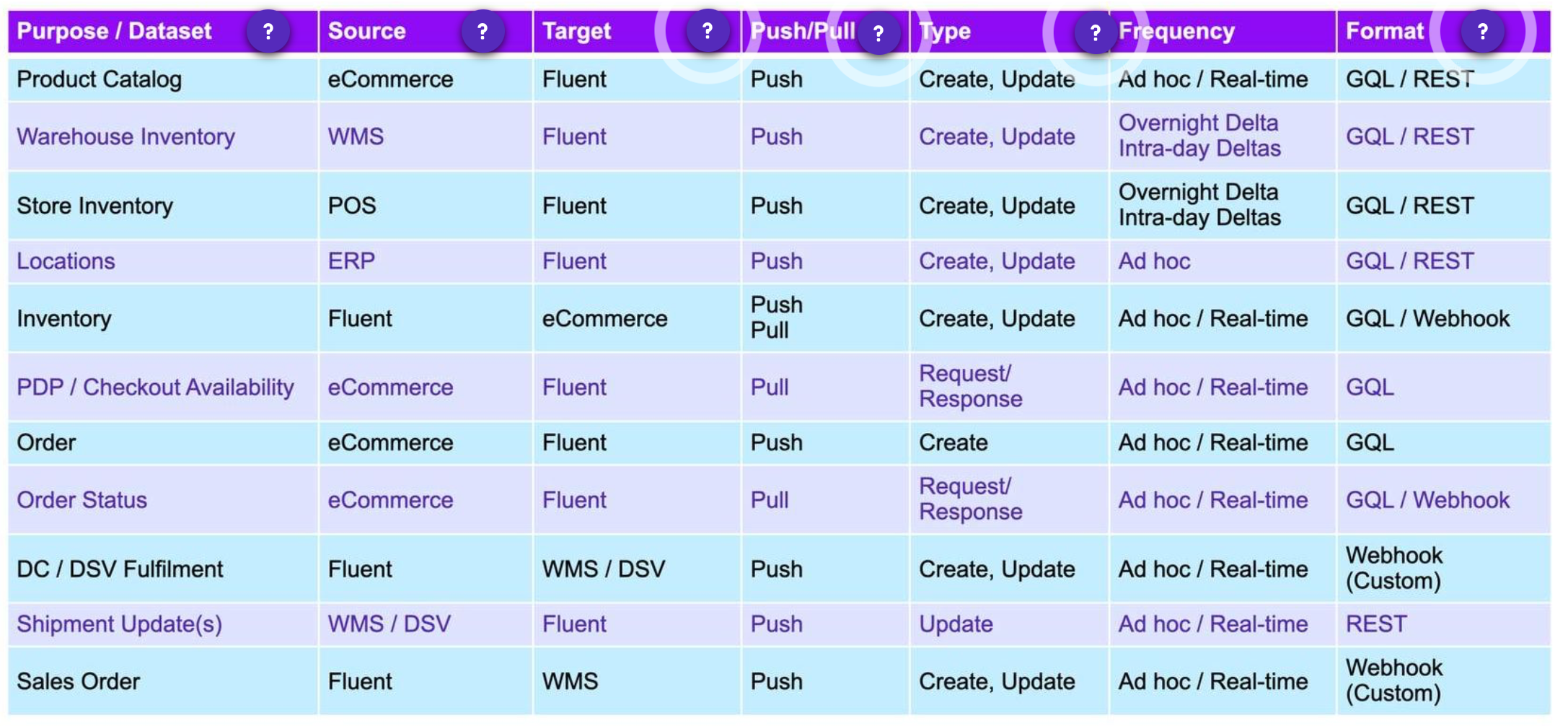
| API Purpose/Dataset | This column states some typical datasets / purpose for an API. |
| API Application Source | This column represents the source application for the respective dataset/purpose. |
| API Integration | This column lists the target API for the respective dataset/purpose. |
| Push / Pull | Push refers to the Source system pushing data to the Target.Pull refers to the Target system pulling data from the Source system. |
| Type & Frequency | These columns show the type and frequency of each integration. |
| API Types | The items listed in this column represent the types of API (e.g. Create, Update) for their respective purpose/dataset (e.g. Product Catalog). |


Copyright © 2024-2026 Fluent Retail Pty Ltd (trading as Fluent Commerce). Unless otherwise expressly stated in a current written agreement with Fluent Commerce or any of its affiliates or on any single page of the docs.fluentcommerce.com site, use of the materials on this site is strictly limited to viewing by individuals over 18 years old for legitimate commercially appropriate reasons; and any downloading, copying or other actions or uses of any kind or by any means of the materials on this site, including by artificial intelligence tools, is strictly prohibited. All other rights reserved.
