
Sourcing Decision Auditability
Feature
Changed on:
3 Sept 2026
Overview
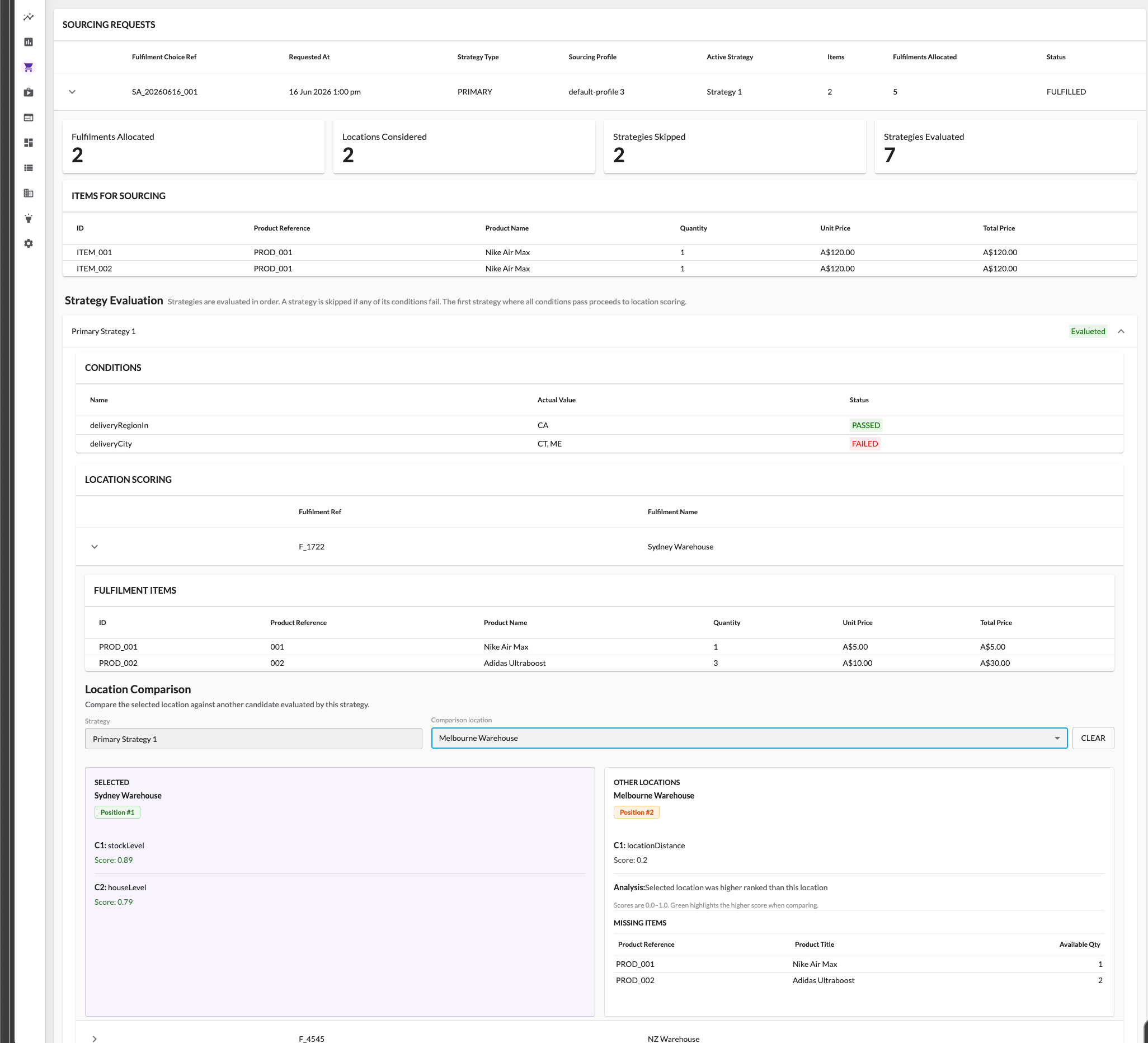
Records an immutable audit of every sourcing request, capturing the inputs that were evaluated, the strategies and conditions considered, and the location ranking that produced each fulfillment.- Captures the resolved sourcing profile and its version in force at the moment of the decision.
- Records each sourcing strategy considered, and the pass or fail result of every sourcing condition within it.
- Retains per-location sourcing criteria scores, location position, and unfulfillable items so considered locations can be compared against the selected one.
How it Works
Each completed sourcing request produces one immutable audit record, available in the Fluent Commerce Order Management System and through the Fluent APIs:- Request-Level Context: The record captures the entity and retailer context, the resolved sourcing profile and version, the master list of items sourced, and an overall status of
`FULLY_SOURCED`,`PARTIALLY_SOURCED`, or`NOT_SOURCED`. A single order can generate several sourcing requests, such as one at creation and another after a short pick, and each produces its own record. - Strategy and Condition Traceability: Every sourcing strategy is recorded in priority order with a status of
`SKIPPED`where a condition failed,`EVALUATED`where its conditions passed and it ran, or`NOT_CONSIDERED`where an earlier strategy had already produced the required fulfillments. Each sourcing condition is stored with its pass or fail result. - Location Comparison: For the strategy that produced the fulfillments, the record retains each considered location with its normalized criteria scores and actual values, its location position before the final available-to-sell check, and the items it could not fulfill. This distinguishes a location ranked lower on criteria from one excluded by an inventory shortfall.
- Controlled Access and Retention: Records are immutable, tenant-isolated, and retained in line with the order and fulfillment data they describe. Viewing requires the
`SOURCINGAUDIT_VIEW`permission, and sourcing profile detail is only populated for users who hold the`SOURCINGPROFILE_VIEW`permission.
Who is This Feature For?
This feature is best suited for:- Operations Managers who need to explain why an order was sourced to one location rather than another when investigating customer complaints or unexpected fulfillment behavior.
- Customer Service Teams who require plain visibility into sourcing decisions to account for delivery behavior without escalating to engineering.
- Product and Engineering Teams who need to validate how a change to a profile, strategy, condition, or criterion affected real fulfillments, and to trace decision flows when debugging.
- Data Analysts and Compliance Owners who rely on historical decision data to identify optimization opportunities and to evidence automated decisions for governance frameworks.
What Problems Does it Solve?
- Explainable Sourcing Outcomes: Recording the criteria score and location position for every considered location identifies exactly which criterion separated the selected location from a closer alternative, and whether inventory was the constraint.
- Faster Issue Resolution: Presenting the full decision trail in the Order Management Interface removes the need to reconstruct decisions from application logs or escalate to engineering, shortening resolution from days to minutes.
- Confident Change Validation: Storing the sourcing profile version alongside the evaluation separates a logic change from an inventory change, so teams can confirm the effect of a tuning change before rolling it out more widely.
- Governance and Compliance Evidence: Immutable, access-controlled, tenant-isolated records provide the evidence trail that enterprise governance and regulatory requirements call for.
- Foundation for Optimization: Historical decision data exposed through the Fluent APIs supports analysis of which criteria configurations produce the best outcomes, and can be consumed into monitoring and analytics tools.
Use Cases
Example
Reference Sourcing Rules:- CreateFulfilmentWithSourcingProfile
- CreatePartialFulfilmentWithSourcingProfile
- CreateRejectedFulfilment
`CreateFulfilmentWithSourcingProfile` and `CreatePartialFulfilmentWithSourcingProfile` create sourcing audit records; `CreateRejectedFulfilment` does not.Reference Sourcing UI Components: