
Order Status Updates - commercetools Connector
Essential knowledge
Intended Audience:
Technical User
Author:
Fluent Commerce
Changed on:
30 June 2026
Overview
Explains how the commercetools Connector captures real-time order lifecycle changes from Fluent Order Management and synchronizes them to commercetools. Partners will learn to deploy a two-stage webhook architecture that processes state updates securely. For the business, this automation unifies header-level order, payment, and shipping milestones, ensuring storefront interfaces display matching records.Note: This article forms part of the inbound pipeline category, where data flows into the commercetools environment from an external source.Key points
- Core Function & Outcome: You will learn how the commercetools Connector captures order webhooks from Fluent to automatically coordinate header-level status updates inside commercetools.
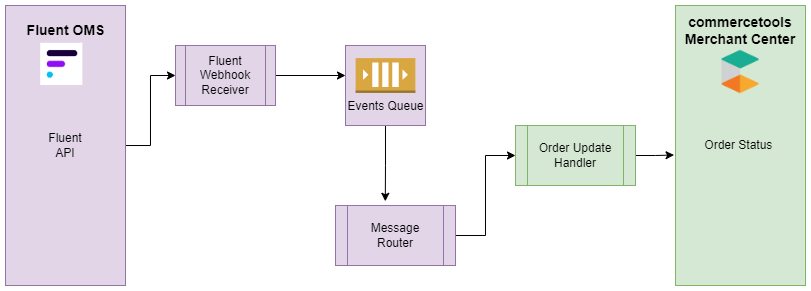
- Two-Stage Processing Framework: Inbound webhooks undergo initial signature and parameter validation in Stage 1 before being enqueued, followed by asynchronous named handler execution in Stage 2.
- Many-to-One Status Mapping: The architectural mapping uses a many-to-one cardinality pattern, allowing multiple distinct Fluent operational statuses to cleanly resolve to a single commercetools state.
- Data Enrichment Pattern: Webhooks transmit minimal payload data, meaning the connector handles downstream processing by executing queries back to Fluent to fetch necessary complete context records.
Data Pipeline Execution
1. Ingestion (Webhook/Batch Job)
Order status updates travel through a decoupled two-stage inbound webhook framework:- Stage 1 (Ingestion & Queueing): The first stage is the validation of the signature and checks that the content has the required parameters. If all goes well, the request is added to the internal message queue to be processed asynchronously; otherwise, the connector will return an error to Fluent to signal that it was unable to accept the request.
2. Processing & Payload Extraction
- Stage 2 (Message Processing): The second stage is the actual processing of the webhook message. The message name is key to driving how the message is going to be processed as these are mapped to internal handlers in the commercetools-connector. Partners can utilize the same approach by adding their own handlers and enabling the processing of different messages that are specific to their end goals.
- All webhooks carry minimal information and require the commercetools-connector to fetch extra details from Fluent in order to complete processing the message received. The system extracts target lifecycle states out of the queue records to prepare them for status mapping evaluations.
3. Target State Mapping (commercetools Mutation/Fields)
In commercetools, there are 3 different order level status mappings processed synchronously by the handler: Order Status Mapping, Payment Status Mapping, and Shipment Status Mapping.- Order Status Mapping: The order status between Fluent and commercetools is kept in Fluent settings. The cardinality for order status mapping is Many-to-one; $N$ number of Fluent order statuses can be mapped to the same single commercetools status.
- Payment Status Mapping: The payment status between Fluent and commercetools is kept in Fluent settings. The cardinality for payment status mapping is Many-to-one; $N$ number of Fluent order statuses can be mapped to the same commercetools payment status. In commercetools, payment status is at the order header level, so the out-of-the-box (OOTB) implementation is mapped against the relevant Fluent order status.
- Shipping Status Mapping: The shipping status between Fluent and commercetools is kept in Fluent settings. The cardinality for shipping status mapping is Many-to-one; $N$ number of Fluent order statuses can be mapped to the same commercetools shipping status. In commercetools, overall shipping status is at the order header level, so the OOTB implementation is mapped against the relevant Fluent order status.
- The handler takes these three mapped values, wraps them inside an update action payload, and runs an update mutation to save the final states inside commercetools.
Data Storage & Schema Mapping
Status Mapping Configuration Profiles
The system executes conversions based on the following standard Fluent settings schema profiles:- Order Status Configuration Key:
`fc.connect.commercetools.order.order-status-mapping`
1{
2  "fluent": {
3    "RECEIVED": "Open",
4    "PENDING_PAYMENT": "Open",
5    "ESCALATED": "Open",
6    "BOOKED": "Confirmed",
7    "PICK_PACK": "Confirmed",
8    "PICK_PACK_CC": "Confirmed",
9    "AWAITING_COURIER_COLLECTION": "Confirmed",
10    "AWAITING_CUSTOMER_COLLECTION": "Confirmed",
11    "COMPLETE": "Complete",
12    "CANCELLED": "Cancelled"
13  }
14}- Payment Status Configuration Key:
`fc.connect.commerce-tools.order.payment-status-mapping`
1{
2    "fluent": {
3        "RECEIVED": "pending",
4        "PENDING_PAYMENT": "pending",
5        "BOOKED": "paid"
6    }
7}- Shipping Status Configuration Key:
`fc.connect.commerce-tools.order.shipping-status-mapping`
1{
2    "fluent": {
3        "RECEIVED": "Pending",
4        "BOOKED": "Pending",
5        "PICK_PACK": "Pending",
6        "AWAITING_COURIER_COLLECTION": "Shipped",
7        "COMPLETE": "Shipped"
8    }
9}Developer Extension Points
Storefront Status Update Mutation
The connector dispatches the following GraphQL statement to modify transaction fields inside commercetools:1mutation Search($id: String!, $version: Long!, $actions: [OrderUpdateAction!]!) {
2 search: updateOrder(id: $id, version: $version, actions: $actions) {
3 id
4 }
5}Inbound Webhook Status Payload
The incoming JSON notification body tracking state modifications follows this schema model:1{
2 "id": "b34281d0-ada4-11e9-a1a7-5da7a83b9sd97cd",
3 "name": "fc.connect.order.webhook.order-status-update",
4 "accountId": "ACME",
5 "retailerId": "1",
6 "rootEntityId": "123",
7 "rootEntityRef": "O_123",
8 "rootEntityType": "ORDER",
9 "entityId": "123",
10 "entityRef": "O_123",
11 "entityType": "ORDER",
12 "entityStatus": "SHIPPED",
13 "type": "NORMAL",
14 "attributes": {}
15}