Category Sync - commercetools Connector
Essential knowledge
Intended Audience:
Technical User
Author:
Fluent Commerce
Changed on:
30 June 2026
Overview
Explains how the commercetools Connector synchronizes category trees from a storefront outbound to Fluent Order Management. Partners will learn to manage real-time subscriptions and batch execution paths to mirror catalog hierarchies. For the business, this automation aligns navigation structures across platforms, ensures consistent item grouping for backend orchestration, and eliminates manual data entry.Note: This article forms part of the outbound pipeline category, where data flows out of the commercetools environment to an external destination.Key points
- Core Function & Outcome: You will learn how the connector coordinates the export of category trees from commercetools to Fluent Order Management, establishing matching catalog nodes across both environments.
- Dual-Trigger Execution: Supports manual, scheduler-driven complete catalog extraction alongside automatic background delta tracking.
- Subscription Management: Relies on core commercetools subscriptions to stream real-time creation and modification alerts into the integration layers.
- Extensible Routing Architecture: Allows business rules, message paths, and handler logic maps to be safely overridden via central YAML configurations. Technical partners can easily reassign event paths, manage inclusion filters, and override standard handler classes inside the centralized
`application-connector.yml`configuration file.
Data Pipeline Execution
1. Storefront Trigger (Subscription/External Queue)
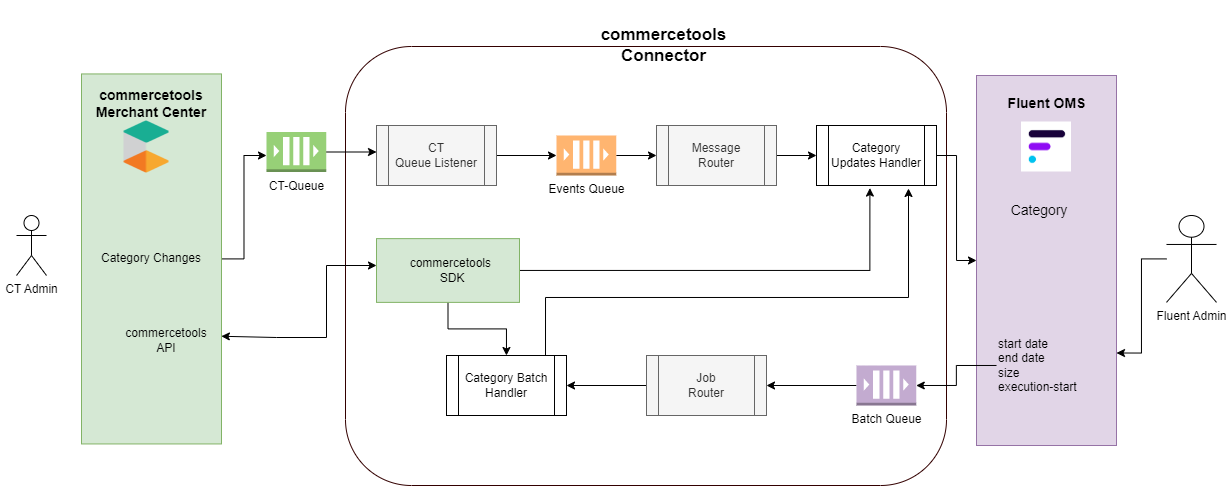
Category record exports can be initiated via two distinct operational trigger paths:- Manual Batch Job: Triggered with the help of an external job scheduler. The number of records pushed depends on the date windows configured within
`Fluent Settings > Product Catalog Sync`. The extension pulls items modified from that designated date until the synchronization starts, implicitly adding categories mapped against those products. - Automatic Delta Sync: An automated background synchronization driven by commercetools subscriptions. Any category creation, modification, or removal pushes messages (supporting
`ResourceCreated`and`ResourceUpdated`variants) directly to the external`ct-queue`. More details on commercetools Subscription.
2. Route Filtering & Message Routing
- Stage 2 (Ingestion & Listening): For automated deltas, the
`CT Queue Listener`reads messages from the`ct-queue`and forwards them to the internal Event Queue. - Stage 3 (Routing Evaluation): The Message Router reads the message name from the Event Queue and routes it to the designated handler. In the case of category updates, the message name resolves to
`category`, which routes to`commercetools.connect.category.upsert`. Bulk requests instead route from a Batch Queue down onto a dedicated Category Batch Handler.
3. Fluent API Delivery (GraphQL Mutation)
- Stage 4 (Payload Delivery): The Category Updates Handler reads message data from the internal queue. Based on the target identifier, it extracts deep category structures from the Commercetools-SDK, transforms the parameters to align with the Fluent data model, and streams the finished configuration outbound to Fluent OMS.
Data Storage & Schema Mapping
Core commercetools Category API Endpoints
The connector queries the following endpoints to pull structural data during processing:`GET: {{host}}/{{project-key}}/categories``GET: {{host}}/{{project-key}}/categories/{{category-id}}`
Developer Extension Points
For more details on how to extend, please refer to the extend guidelines.Message Routing Configuration (`application-connector.yml`)
Please refer to commercetools Category Messages for more information on supported messages from CT.1fluent-connect:
2 - route: "commercetools.connect.category.upsert"
3 props:
4 name: "category"
5 inclusion-filter:
6 - "ResourceUpdated"
7 - "ResourceCreated"
8 - route: "commercetools.connect.category.deactivate"
9 props:
10 name: "category"
11 inclusion-filter:
12 - "ResourceDeleted"Custom Message Handler Implementation
Custom data transformation strategies can be introduced by creating a class extending`MessageHandler` registered under the main SDK package directory:1@Slf4j
2@Component
3@HandlerInfo(name = "FluentCategoryUpsert", description = "Upsert a category at Fluent OMS")
4public class FluentCategoryCreateHandler extends MessageHandler {
5 private static final String CATEGORY_ATTRIBUTE = "category";
6 // write your logic
7}Category Message Payload Reference
The following schema payload illustrates the structure of a category update event notice as delivered to the internal queues:1{
2 "notificationType": "Message",
3 "projectKey": "fluent-ct-dev",
4 "id": "96be0961-6b89-4ea8-b9e7-3c367e769f68",
5 "version": 1,
6 "sequenceNumber": 1,
7 "resource": {
8 "typeId": "category",
9 "id": "3f1d5cf9-e5f3-47eb-aa97-a845279c26f4"
10 },
11 "resourceVersion": 1,
12 "resourceUserProvidedIdentifiers": {
13 "slug": {
14 "en": "heel-shoes"
15 }
16 },
17 "type": "ResourceCreated",
18 "category": {
19 "id": "3f1d5cf9-e5f3-47eb-aa97-a845279c26f4",
20 "version": 1,
21 "versionModifiedAt": "2022-07-29T02:30:57.180Z",
22 "lastMessageSequenceNumber": 1,
23 "createdAt": "2022-07-29T02:30:57.180Z",
24 "lastModifiedAt": "2022-07-29T02:30:57.180Z",
25 "lastModifiedBy": {
26 "isPlatformClient": true,
27 "user": {
28 "typeId": "user",
29 "id": "0b28d312-6263-4fba-a0a4-da389fa7aef7"
30 }
31 },
32 "createdBy": {
33 "isPlatformClient": true,
34 "user": {
35 "typeId": "user",
36 "id": "0b28d312-6263-4fba-a0a4-da389fa7aef7"
37 }
38 },
39 "name": {
40 "en": "Heel Shoes"
41 },
42 "slug": {
43 "en": "heel-shoes"
44 },
45 "description": {
46 "en": "All Heel Shoes"
47 },
48 "ancestors": [],
49 "parent": {
50 "typeId": "category",
51 "id": "a122bf5e-feb4-4378-a37e-44306078d7ce"
52 },
53 "orderHint": "c2",
54 "assets": []
55 },
56 "createdAt": "2022-07-29T02:30:57.180Z",
57 "lastModifiedAt": "2022-07-29T02:30:57.180Z"
58}